Add a Curriculum Bundle to Your Account!
Please select a bundle.



The Pack contains associated resources for the learning experience, typically in the form of articles and videos. There is a teacher Pack (with only teacher information) and a student Pack (which contains only student information). As a teacher, you can toggle between both to see everything.
Here are the teacher pack items for South Asia: Society and Culture:

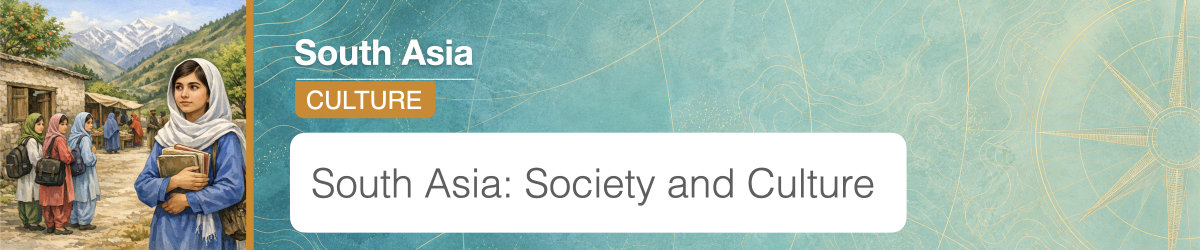
Overview: In this experience, students examine how cultural patterns, social institutions, and changing ideas shape daily life in South Asia. They research culture and society in India, Pakistan, and Bangladesh, then investigate the historical caste system as an example of how religious ideas and social roles became connected and changed over time. Finally, students study Malala Yousafzai as an example of how education, communication, and civic action can challenge social restrictions and contribute to cultural change. Objectives:
People in every society learn ways of living from the people and institutions around them. Families may pass on languages, traditions, and expectations. Religious institutions can influence beliefs and practices. Schools teach knowledge and skills, while governments create laws that affect people’s daily lives.
These influences are part of culture. Cultural patterns can affect what people eat, wear, celebrate, learn, create, and value. They can also influence expectations about family life, education, work, and social roles.
South Asia includes many languages, religions, ethnic groups, traditions, and ways of life. India, Pakistan, and Bangladesh share parts of their history, but each contains many different communities and cultural traditions. No single example represents everyone in any of these countries.
Culture also changes. New technology, economic development, migration, education, and the actions of individuals and groups can affect how people communicate, work, learn, and understand social roles.
In this experience, you will examine cultural patterns and institutions in South Asia, investigate how social roles have developed and changed, and explore how individuals can influence society.
Objectives:
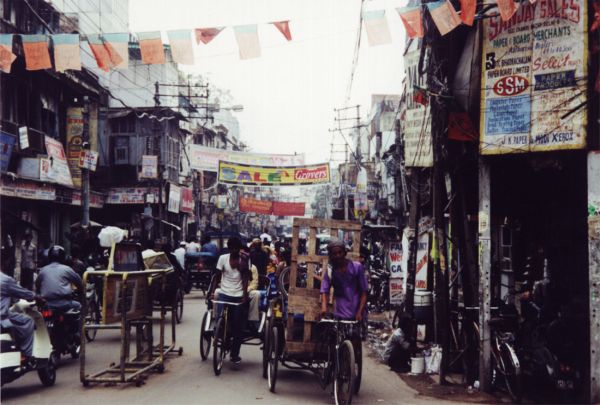
Busy New Delhi Market
What is one detail in the image that could tell you something about how people live, work, learn, or interact in this society? Explain what you can observe without making assumptions about the people shown.
After students respond, invite several students to identify the evidence they used. Use the discussion to distinguish observation from assumption. Explain that photographs can provide evidence about clothing, transportation, buildings, work, public spaces, technology, or community activity, but they cannot tell us everything about a person's beliefs or identity. Use students' observations to introduce the idea that daily life is influenced by many institutions and cultural patterns. Possible follow-up questions include:
Assign each student or group one of the following countries:
Distribute the countries as evenly as possible. When everyone is ready to continue, unlock the next scene.


