Add a Curriculum Bundle to Your Account!
Please select a bundle.




The Pack contains associated resources for the learning experience, typically in the form of articles and videos. There is a teacher Pack (with only teacher information) and a student Pack (which contains only student information). As a teacher, you can toggle between both to see everything.
Here are the teacher pack items for The War on Terror:

Overview In this experience, students first create a class K-W chart about the Sept. 11 attacks. Then they learn the basic facts about the attacks. Next they examine the U.S. response and rewrite in their own words an excerpt from President Bush’s speech to the nation. Finally they learn about the role of first responders and consider the impact they had during and after the attacks.. The Student Pack contains a link to the 9/11 Memorial website, which contains an extensive set of primary sources and timelines of the attacks and recovery. You may use this experience as background, and then use the site to extend the lesson to additional activities, for example primary source analysis, interviews, writing narrative, or creating a class newspaper for September 12, 2001. This lesson addresses the September 11 attacks and the events that followed. Some students may find the topic upsetting or may have personal or family connections to the events, military service, or later conflicts. Present the material in a factual, age-appropriate way and avoid unnecessary graphic details. Encourage students to ask questions and keep discussion focused on the historical events, their effects, and the decisions made afterward. Be careful to distinguish the actions of specific terrorist organizations and individuals from larger religious, ethnic, or national groups. If students make broad generalizations, guide them back to the specific people, organizations, and evidence discussed in the lesson. Estimated duration: 40-50 minutes Discovery Reading A printable Discovery Reading is included in the student pack as a support for understanding the experience’s core content and concepts. This Discovery Reading is not necessary to complete the experience and serves as an optional support resource. Vocabulary Words: These vocabulary words are used in the experience or connect closely to the standards and content students examine. Students should understand these terms as they work through the experience. Objectives
On September 11, 2001, terrorists hijacked four passenger airplanes in the United States. Two planes were flown into the World Trade Center towers in New York City. A third plane struck the Pentagon, the headquarters of the U.S. Department of Defense. On the fourth plane, passengers and crew members fought back against the hijackers, and the plane crashed in a field in Pennsylvania.
The attacks killed thousands of people and changed the way many Americans thought about safety, security, and the country’s role in the world. In this lesson, you will learn about the events leading up to and following the attacks of September 11, often called 9/11.
Objectives
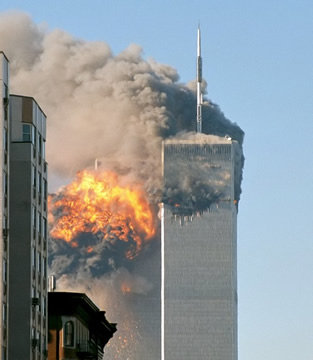
One of the hijacked jets flies into the World Trade Center
In the table below, share one thing you know about the September 11 attacks. You may add a new idea or build on something another student has shared. If you do not know much about the event yet, that is okay. Post one question you have about 9/11 instead.

Students are not required to post to the table in order to move on. Use the table to get a reading of what students already know about 9-11. View any questions that they post and ensure that the questions are addressed, either directly or by referring the student to additional reading.
When everyone is ready to continue, unlock the next scene.


