Add a Curriculum Bundle to Your Account!
Please select a bundle.




The Pack contains associated resources for the learning experience, typically in the form of articles and videos. There is a teacher Pack (with only teacher information) and a student Pack (which contains only student information). As a teacher, you can toggle between both to see everything.
Here are the teacher pack items for Conflict Between Colonists and the British:


Overview In this experience, students examine a series of maps of European colonization between 1497–1763. Then they read about the French and Indian War, focusing on its outcome. Next they analyze the slogan “No taxation without representation.” Finally, they give a close reading of the words to the song “Yankee Doodle.” Estimated duration: 30-40 minutes Discovery Reading A printable Discovery Reading is included in the student pack as a support for understanding the experience’s core content and concepts. This Discovery Reading is not necessary to complete the experience and serves as an optional support resource. Vocabulary Words: These vocabulary words are used in the experience or connect closely to the standards and content students examine. Students should understand these terms as they work through the experience. Objectives
The British colonies did not decide to break away from Britain in one day. Many events over several years led to the American Revolution. It was a war for Independence. In this lesson, you will learn about one important event that pushed some colonists toward revolution.
.
Objectives
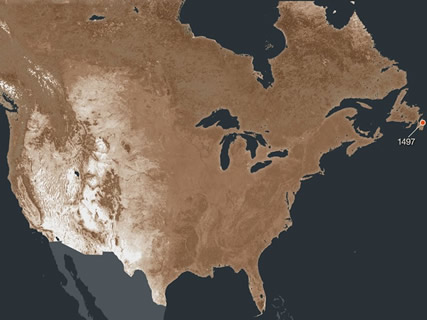
North American Colonization from 1497 to 1763
By the 1750s, the British colonies had grown. They included busy cities and towns, as well as many farms. Spain had colonies in parts of southern North America. France claimed a large area of North America. France had fewer settlers than Britain, but it had towns, forts, and trading posts. European countries claimed this land. However, Indigenous peoples already lived on it.
Click through the map slideshow above to see how European colonies and land claims changed between 1497 and 1750.
Help students interpret the maps as they click through them.
Which country had a claim to the most land in 1750, on the eve of the war known as the French and Indian War?
When everyone is ready to continue, unlock the next scene.


