Add a Curriculum Bundle to Your Account!
Please select a bundle.




The Pack contains associated resources for the learning experience, typically in the form of articles and videos. There is a teacher Pack (with only teacher information) and a student Pack (which contains only student information). As a teacher, you can toggle between both to see everything.
Here are the teacher pack items for Austin’s Texas Colony:

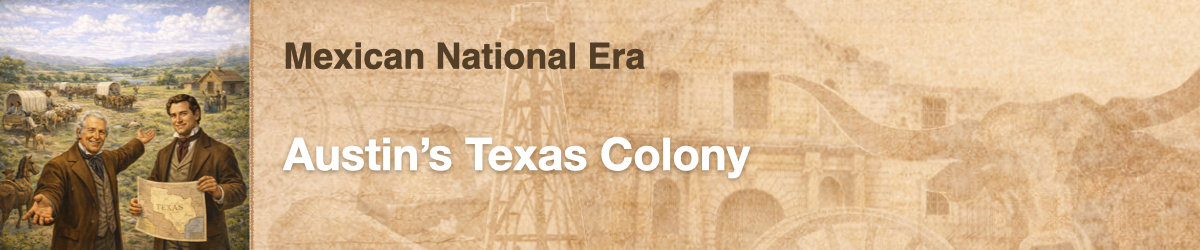
Overview In this experience, students learn about Moses and Stephen Austin and their role in the settlement of Texas. They read about the Austin colony and land grant conditions and requirements. Then they work in small groups to prepare a recruitment poster on behalf of the Austin colony. Students will collaborate in small groups for scene 3 and scene 4. Note that there are three interrelated experiences that deal with settlement of Texas in the period of 1821–1830: There are two general resources provided to students in the pack of all three experiences: a timeline of events in Texas history from 1826–1842 and a video (30 minutes). You can refer students to these resources at any point during these experiences. Objectives:
Stephen F. Austin is often called the “Father of Texas,” but the plan to establish an Anglo-American colony in Texas began with his father, Moses Austin. Moses received permission from Spanish authorities to bring 300 families to Texas, but he died before he could carry out the plan. Stephen continued his father’s colonization project under the new Mexican government.
In this lesson, you will learn about the roles Moses and Stephen F. Austin played in bringing Anglo-American settlers to Mexican Texas.
Objectives:
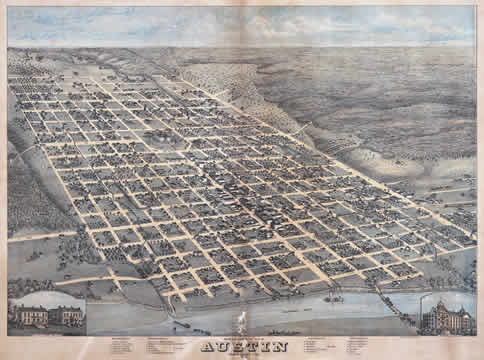
Map of Austin, Texas, 1873
The city of Austin was named for Stephen F. Austin. Many downtown streets also have names connected to Texas geography and history. For example, Colorado Street and San Jacinto Boulevard are named for important places in Texas.
Street names can reveal what people and places a community has chosen to remember.
Look at these downtown Austin street names: Colorado What do these street names suggest Austin’s planners wanted to remember?
Brazos
Guadalupe
San Jacinto
Lavaca
Nueces
Trinity
All the north-south streets are named for major Texas rivers: Red River, Trinity, Brazos, Rio Grande, Lavaca, Guadalupe, San Antonio, Nueces, Rio Grande, Neches, and Sabine. Students who are familiar with Austin may know that the east-west downtown streets are all numbered: 1st Street (renamed Caesar Chavez and running along the Colorado River), and then the streets run from 2nd Street to 19th Street (renamed Martin Luther King Jr. Boulevard and forming the border between downtown and the University of Texas campus).
When everyone is ready to continue, unlock the next scene.