Add a Curriculum Bundle to Your Account!
Please select a bundle.




The Pack contains associated resources for the learning experience, typically in the form of articles and videos. There is a teacher Pack (with only teacher information) and a student Pack (which contains only student information). As a teacher, you can toggle between both to see everything.
Here are the teacher pack items for Spanish Colonization and Native Americans:


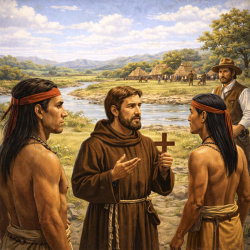
Overview In this experience, students examine the complex relationships between Spanish missionaries, settlers, soldiers, and Indigenous nations in Texas. They learn about several distinct Native peoples, their ways of life, and their varied relationships with the Spanish. Students also examine a passage by Father Francisco Hidalgo to consider his perspective toward Indigenous peoples. Finally, they investigate one historical issue from the era of Spanish colonization and explain it from two perspectives: a Spanish missionary and an Indigenous person affected by the mission system. Estimated Duration: 45–60 minutes Vocabulary Words: Objective:
Long before Spanish and French explorers arrived, many distinct Indigenous nations lived on the land that is now Texas. They had their own languages, governments, traditions, trade networks, and relationships with the land. Different communities hunted, farmed, gathered food, traded, and used local resources in different ways.
When Spanish and French explorers entered the region, they encountered societies that were already well established. The land was unfamiliar to the Europeans, but the Europeans were the newcomers to the Indigenous peoples who lived there.
Objective:
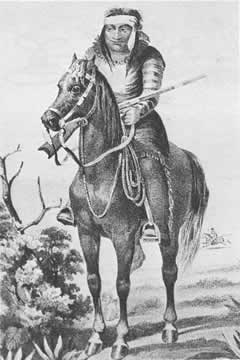
A Lipan Apache
When you think of the impacts of Spanish colonization on Native Americans, what words come to mind? To list more than one word separate them with a comma such as: dog, cat.
Native American tribes in Texas during the Spanish colonial era included: Apaches, Comanches, Wichitas, Caddo, Jumanos, Coahuiltecan, Tonkawas, Hasinai Indians, Tay-sha or Tejas, Natchitoch.
When everyone is ready to continue, unlock the next scene.