Add a Curriculum Bundle to Your Account!
Please select a bundle.





The Pack contains associated resources for the learning experience, typically in the form of articles and videos. There is a teacher Pack (with only teacher information) and a student Pack (which contains only student information). As a teacher, you can toggle between both to see everything.
Here are the teacher pack items for Fighting Heroes of World War II:


Overview In this experience, students brainstorm the characteristics of a hero. Then they learn about the Tuskegee Airmen and how their service challenged racial discrimination in the U.S. military and contributed to later integration. Next, they learn about the 442nd Regimental Combat Team and the incarceration of Japanese Americans during World War II, including the contrast between Japanese American military service and discrimination at home. Students then learn about the Navajo Code Talkers and how they used their language and a specially developed code to help U.S. forces communicate during the war. Finally, students choose one of the three groups and write a short statement recognizing the group’s service, the challenges it faced, and why its contributions should be remembered. If you have access to leveled readers that include stories about the Tuskegee Airmen or the Navajo Code Talkers, assign them to the students in parallel to this experience. Estimated duration: 35-45 minutes Discovery Reading A printable Discovery Reading is included in the student pack as a support for understanding the experience’s core content and concepts. This Discovery Reading is not necessary to complete the experience and serves as an optional support resource. Vocabulary Words: These vocabulary words are used in the experience or connect closely to the standards and content students examine. Students should understand these terms as they work through the experience. Objectives
During World War II, many people showed courage in different ways. Soldiers fought in dangerous conditions, some people risked their lives to hide or help Jewish people and others targeted by the Nazis, and people on the home front supported the war effort in many ways. In this experience, you will learn about three groups whose courage and service made an important difference during the war.
Objectives
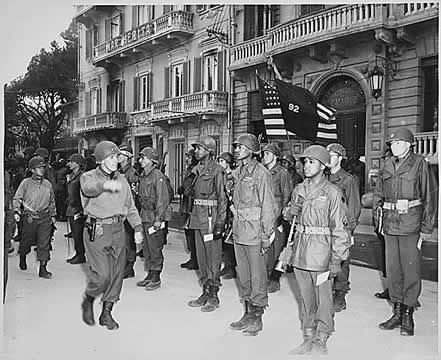
A U.S. major general inspects his troops during a decoration (medal) ceremony in Italy
Think about someone who you consider a hero. What makes them a hero? In a word or short phrase, post one or more characteristics of a hero.
Discuss student responses. Try to reach a class consensus or generate a criteria list about what makes someone a hero.
When everyone is ready to continue, unlock the next scene.


