Add a Curriculum Bundle to Your Account!
Please select a bundle.


The Pack contains associated resources for the learning experience, typically in the form of articles and videos. There is a teacher Pack (with only teacher information) and a student Pack (which contains only student information). As a teacher, you can toggle between both to see everything.
Here are the teacher pack items for Arabia and Iraq: Government and Economy:

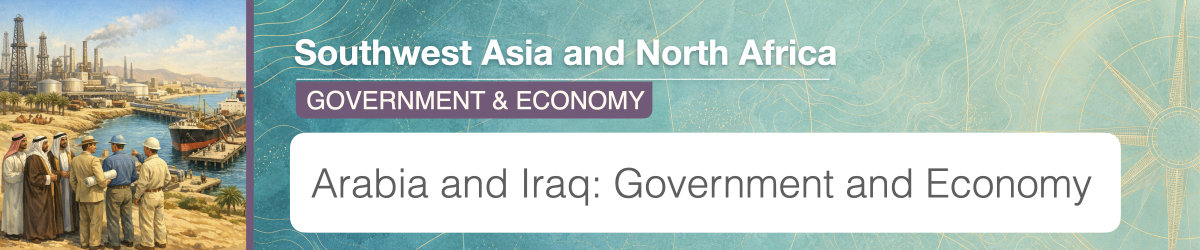
Overview In this experience, students examine the different forms of government and major economic patterns found across Iraq and the Arabian Peninsula. They compare how natural resources, especially oil and natural gas, influence government revenue, trade, infrastructure, and economic development, while also considering the risks of depending heavily on one resource. Finally, students apply what they have learned by identifying an economic strength and challenge in one country and proposing a government action that could support future development. In scene 2, students will work in small groups to explore political and economic features of a specific country. This is a discussion-rich experience, so if you need to set ground rules for respectful group work and discussions, do so before the experience begins. Objectives:
Governments make decisions about how resources are used, how economies develop, and how countries interact with the rest of the world. In Iraq and the Arabian Peninsula, these decisions have been strongly influenced by geography and natural resources.
Oil and natural gas have brought significant income to many countries in the region and helped support the growth of cities, infrastructure, and international trade. At the same time, countries have developed different forms of government and are working in different ways to expand their economies beyond energy resources.
In this experience, you will examine how government, natural resources, trade, and economic development are connected across Iraq and the Arabian Peninsula.
Objectives:
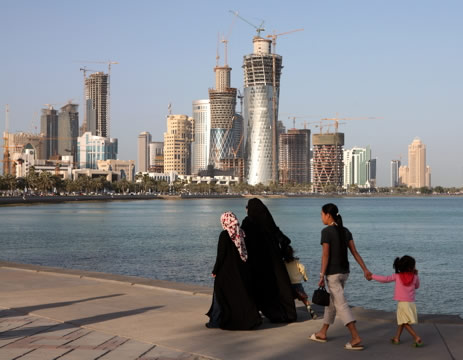
Doha, Qatar
What do you think gives a country economic power? Answer with one word. To answer with more than one idea, separate the words like this: cat, dog.
As the word cloud develops, ask students to look for patterns in the ideas that appear. Group similar responses into broader categories such as natural resources, trade, money, technology, workers, location, or industry. Do not identify one correct answer. Explain that economic power can come from several sources, and the rest of the experience will test which factors have been especially important in Iraq and the Arabian Peninsula. Possible follow-up questions include:
Divide students into their small groups for the next scene. Assign each group one of the following countries: Saudi Arabia, Kuwait, Bahrain, Qatar, United Arab Emirates (UAE), Oman, and Yemen.
Assign a note taker and reporter to upload the report for each group, or tell the students to choose their own reporter.
When everyone is ready to continue, unlock the next scene.


