Add a Curriculum Bundle to Your Account!
Please select a bundle.




The Pack contains associated resources for the learning experience, typically in the form of articles and videos. There is a teacher Pack (with only teacher information) and a student Pack (which contains only student information). As a teacher, you can toggle between both to see everything.
Here are the teacher pack items for Religion and Its Influence: The Origins of the Abrahamic Religions:

Overview In this experience, students examine the origins, beliefs, sacred texts, important figures, and observances of Judaism, Christianity, and Islam. They compare the three religions to identify both shared traditions and important differences. Finally, students explore the role of Abraham in each religion and explain why Judaism, Christianity, and Islam are known as the Abrahamic religions. Objectives:
Religion has influenced societies for thousands of years. Religious beliefs can shape traditions, holidays, art, architecture, laws, community life, and the ways people understand the world.
Three religions that began in Southwest Asia have had especially widespread influence: Judaism, Christianity, and Islam. Each developed at a different time and has its own beliefs and practices, but they also share important historical and religious connections. All three teach belief in one God and include many of the same people and stories in their religious traditions.
Because Abraham is an important figure in all three traditions, Judaism, Christianity, and Islam are often called the Abrahamic religions.
In this experience, you will examine the origins, beliefs, sacred texts, important figures, and observances of Judaism, Christianity, and Islam. You will then compare the three religions and investigate why Abraham is important to each tradition.
Objectives:

What similarities or differences would you expect to find among three religions that developed in the same broad region but at different times? Explain your thinking.
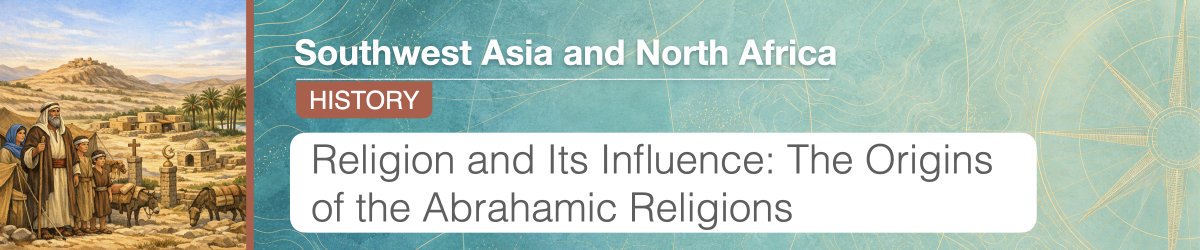
After students respond, invite several students to share the similarities or differences they predicted. Record a few ideas, but do not confirm or correct them yet. If students recognize the symbols in the image, identify the Star of David as commonly associated with Judaism, the cross with Christianity, and the crescent and star as commonly associated with Islam. Clarify that religious traditions contain many symbols and that not every member of a religion uses or interprets symbols in the same way. Use the discussion to establish the question students will investigate throughout the experience: how can three distinct religions share historical connections while developing different beliefs and practices? Possible follow-up questions include:
When everyone is ready to continue, unlock the next scene.


