Add a Curriculum Bundle to Your Account!
Please select a bundle.


The Pack contains associated resources for the learning experience, typically in the form of articles and videos. There is a teacher Pack (with only teacher information) and a student Pack (which contains only student information). As a teacher, you can toggle between both to see everything.
Here are the teacher pack items for Religion and Its Influence: The Origins of Islam:

Overview In this experience, students examine the origins of Islam, major events in its early history, and central beliefs and practices, including the Five Pillars. They then explore Ramadan as an example of how religious observance can shape daily life, family traditions, and culture. Finally, students create an infographic that uses evidence from the experience to explain a larger theme, such as how religious ideas spread, how religion influences culture, or how shared beliefs connect people across different societies. Objectives:
Islam is one of the world’s major religions. It began on the Arabian Peninsula in the 600s C.E. and developed within a region connected by trade, travel, and contact among different peoples and religious traditions.
Like other major religions, Islam includes beliefs, practices, sacred texts, places of worship, and traditions that have shaped the lives of people and communities over time. As Islam spread beyond the Arabian Peninsula, it also influenced societies in Africa, Asia, Europe, and other parts of the world.
In this experience, you will examine the origins of Islam, learn about some of its central beliefs and practices, and explore ways Islam has influenced societies and cultures over time. As you study, remember that Muslims, like members of any large religious tradition, do not all practice or experience their faith in exactly the same way.
Objectives:
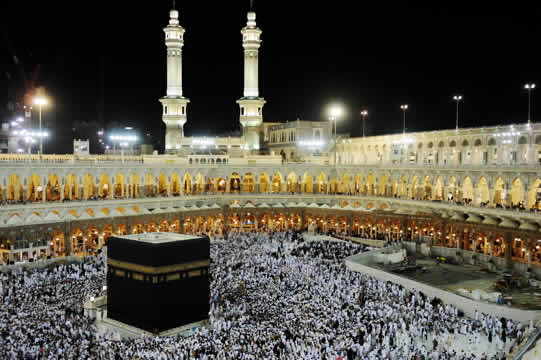
Pilgrims in Mecca, Saudi Arabia
To begin your study of Islam, watch this brief video:
Based on what you saw in the video, write one question you have about Islam, Mecca, or why Mecca is important to Muslims.
After students write their questions, invite several students to share. Record a few examples and look for common themes, such as Mecca, Muhammad, religious beliefs, worship, sacred places, or the early history of Islam. Do not answer the questions yet. Use them to identify what students are curious about and to preview the ideas they will investigate in the rest of the experience. Possible follow-up questions include:
When everyone is ready to continue, unlock the next scene.


